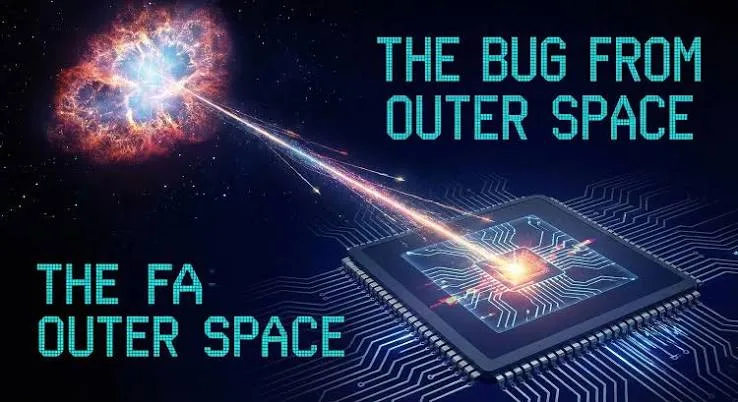
#Belgium #Elections In 2003, a municipal election in Belgium produced a result that was mathematically impossible. 🗳️ One candidate received 4,096 extra votes, even though the total number of ballots cast was lower. 🔍 Investigators suspected fraud. But there were no fake ballots, no hacked software, and no human error. The voting machines passed every technical audit. ⚛️ The explanation came from physics. Scientists found that a single bit in the machine’s memory flipped from 0 to 1. Because computers count in binary, that one flipped bit instantly added exactly 4,096 votes. ☄️ The phenomenon was first identified in the 1960s by physicist John R. Pierce, who showed that cosmic rays can strike electronic circuits and alter stored data. This effect is now known as a Single Event Upset. 🧠 In other words, the voting machine didn’t malfunction. A particle from outer space briefly rewrote the election result. 🚨 The case stunned engineers worldwide and changed how critical systems are designed, leading to the use of error-correcting memory in voting machines, aircraft, and satellites. 📌 A reminder that sometimes history isn’t shaped by humans or machines… but by the universe itself. #Science #Technology
 One candidate received 4,096 extra votes, even though the total number of ballots cast was lower.
 Investigators suspected fraud. But there were no fake...